डॉ. बी. आर. अम्बेडकर विश्वविद्यालय दिल्ली



Introduction
Established as one of the early Schools of Dr. B.R. Ambedkar University Delhi, the School of Human Ecology (SHE) emerged from the recognition that environmental challenges cannot be understood through disciplinary silos alone.
Since its inception, the School has developed interdisciplinary teaching and research programmes that integrate ecology, anthropology, history, economics, geography, environmental sciences, political ecology, and public health to understand the complex relationships between human societies, non-human life, and the biophysical environment.
Over the years, SHE has built a strong culture of field-based learning, research engagement, and critical inquiry through its MA programme in Environment and Development and PhD programme in Human Ecology.
Through teaching, research, and public engagement, SHE seeks to build scholars and practitioners capable of addressing socio-ecological problems across scales—from forests and farmlands to cities, institutions, and global environmental transformations.
Vision
SHE envisions a world where ecological sustainability, social justice, and democratic engagement guide relationships between human societies and the environment.
Mission
The School seeks to:
- Foster interdisciplinary teaching and research on socio-ecological systems
- Bridge the natural sciences, social sciences, and humanities
- Promote field-based, empirically grounded learning
- Engage critically with issues of environmental justice, sustainability, livelihoods, governance, and conservation
- Develop scholars and practitioners equipped to address contemporary environmental challenges
- Encourage ethical, socially engaged, and reflexive research practices
What is Human Ecology?
Human Ecology is the interdisciplinary study of relationships between humans, non-human life, and the environments they inhabit and transform. It examines how ecological processes, economies, politics, culture, technology, history, and systems of knowledge interact to shape human-environment relationships across time and space. Human Ecology moves beyond the separation of “nature” and “society” by understanding environmental issues as simultaneously ecological, social, political, historical, and ethical.
As a field, it draws from ecology, anthropology, geography, economics, environmental history, political ecology, sociology, public health, and allied disciplines to address contemporary challenges such as climate change, biodiversity loss, urban transformation, environmental conflict, displacement, public health crises, agrarian change, and sustainability transitions.
In a rapidly changing world, Human Ecology equips students and researchers to critically engage with sustainability transitions, policy processes, conservation challenges, environmental governance, community resilience, and questions of justice in the Anthropocene.
At SHE, Human Ecology is approached through interdisciplinary learning, critical inquiry, and field-based engagement with real-world socio-ecological systems.
Career Prospects
Contemporary environmental crises increasingly reveal that ecological problems are inseparable from questions of inequality, governance, livelihoods, technology, health, and culture. Climate change, biodiversity loss, pollution, water stress, displacement, agrarian distress, and urban ecological crises demand interdisciplinary approaches capable of studying complex socio-ecological systems. Human Ecology provides precisely such an approach by integrating ecological understanding with social analysis, historical perspective, and field-based research.
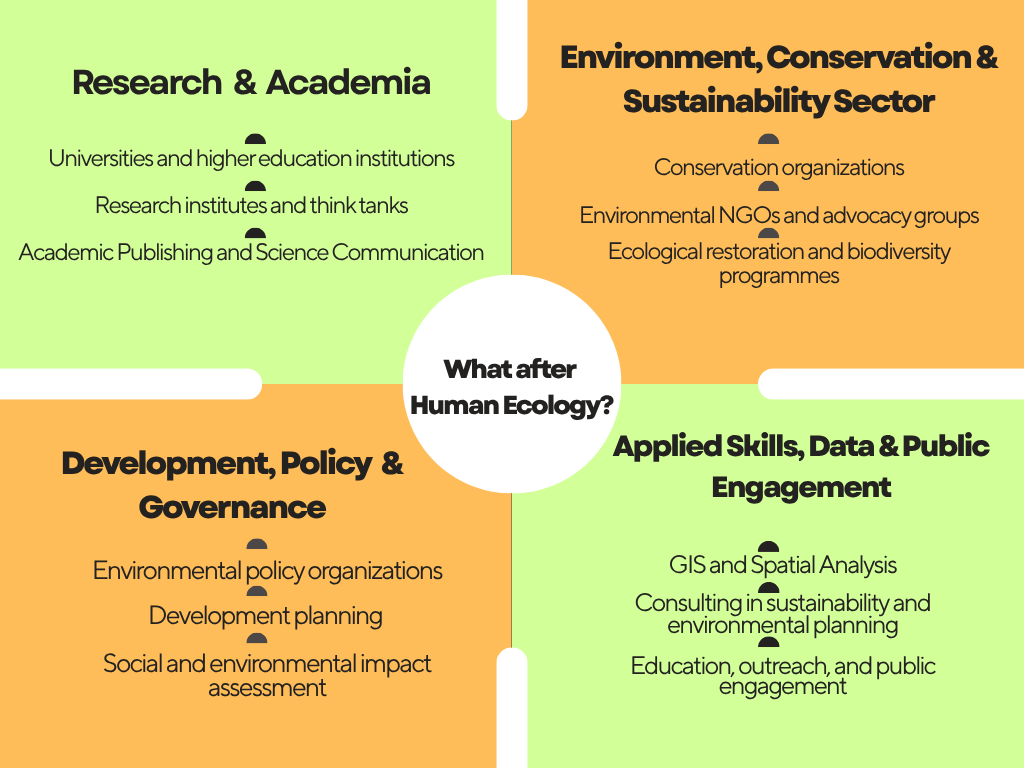
Graduates from SHE pursue careers across a wide array of avenues: